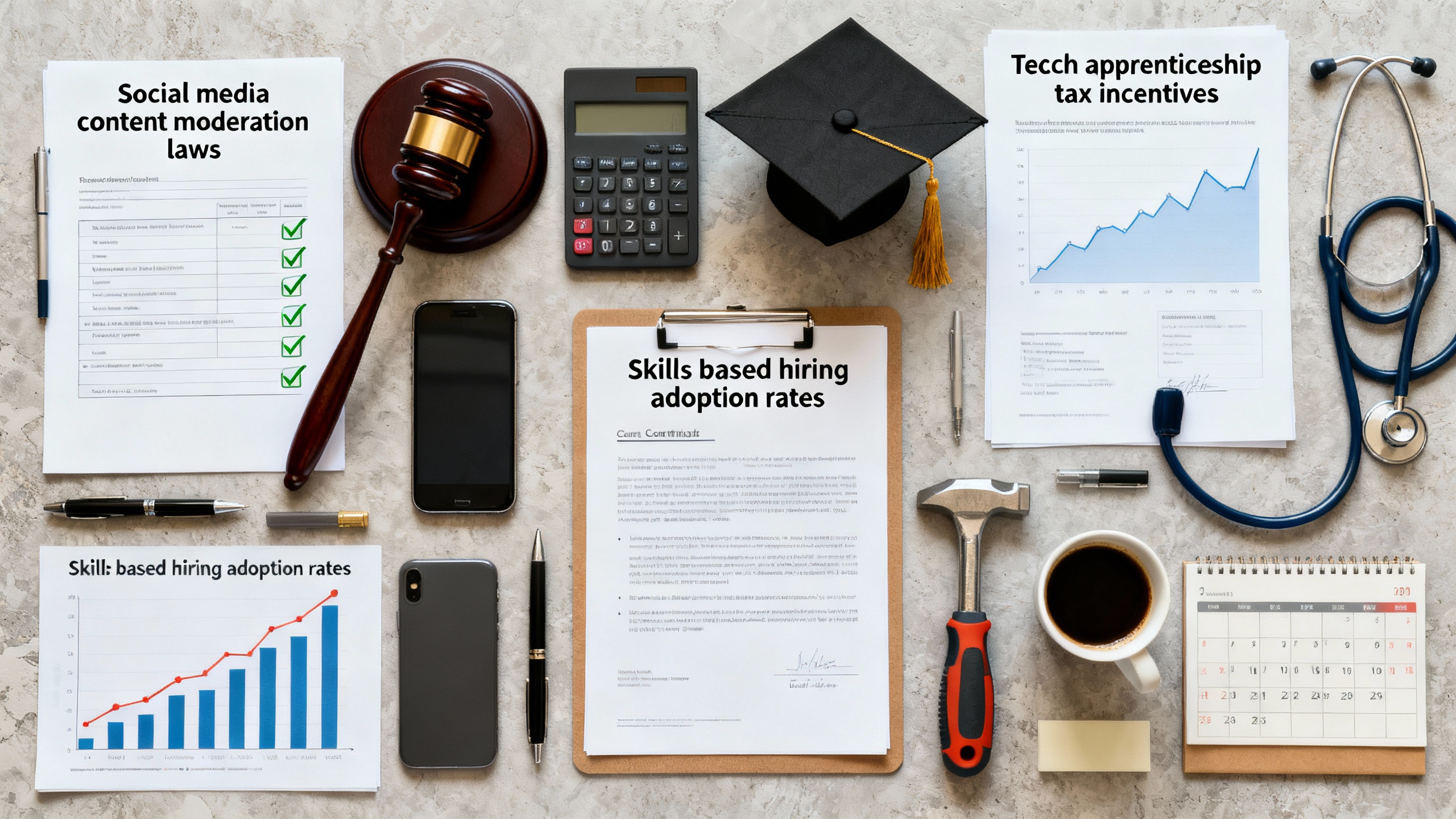
60% of companies now use skills-based hiring—up 50% from 2020—driven by urgent labor shortages, according to 2024 U.S. Labor Department reports and American Hospital Association studies. This 2024 guide covers adoption rates (65% in U.S. tech), social media content moderation laws (like Japan’s 24-hour removal mandates), and tech apprenticeship tax incentives (vital for 78% of firms struggling to fill entry-level roles, per LinkedIn’s 2024 Talent Trends). Compare premium skills assessments vs outdated degree checks, get best price guarantees on compliance software, and access free local tax audit tools to meet 2024 deadlines. California Skills First compliant and Texas-friendly resources included.
Skills-based hiring adoption rates
60% of companies worldwide now use skills-based hiring practices—a 50% increase from just 40% in 2020—marking a seismic shift away from degree-centric recruitment models. This rapid adoption reflects employers’ urgent response to labor shortages, particularly in critical sectors like healthcare and technology, where specialized skills have become the cornerstone of workforce resilience.
Adoption rates
Global trends
The global rise in skills-based hiring accelerated post-pandemic, driven by the need to fill roles faster and bridge skill gaps. A 2024 industry analysis found that organizations prioritizing skills over credentials reported 30% shorter time-to-hire and 25% higher retention rates compared to traditional hiring methods. Regions like the EU and APAC are following suit, with the European Commission’s 2023 workforce strategy explicitly recommending skills-based frameworks to address labor market inefficiencies.
U.S. national data
In the U.S., adoption has outpaced global averages, fueled by "escalating labor shortages in critical infrastructure sectors" (2024 U.S. Labor Department reports). As of 2024, 65% of U.S. companies have integrated skills assessments into their hiring workflows, with state-level initiatives—such as California’s 2023 "Skills First" legislation—further incentivizing adoption. Notably, manufacturing and IT sectors lead with 70% and 68% adoption rates, respectively.
Industry-specific adoption
Healthcare stands out as a key adopter, with skills-based hiring shown to "accelerate talent acquisition, foster innovation, and strengthen care delivery" (American Hospital Association 2024 study). The sector’s adoption rate reached 62% in 2024, up from 38% in 2020, as hospitals prioritize clinical competencies over strict degree requirements for roles like medical technologists and nurse practitioners.
| Industry | 2020 Adoption Rate | 2024 Adoption Rate | Growth |
|---|---|---|---|
| Healthcare | 38% | 62% | +24% |
| Manufacturing | 45% | 70% | +25% |
| IT Services | 50% | 68% | +18% |
| Finance | 30% | 45% | +15% |
Barriers to adoption
Despite progress, organizations face significant hurdles. A primary challenge is the persistence of "academically-centric hiring approaches" that fail to "accurately reflect an individual’s ability to perform in real-world settings" (Society for Human Resource Management 2024). In healthcare, this is compounded by a "lack of specialized skills" in the labor pool, creating a paradox where employers struggle to find candidates with both technical expertise and practical experience.
Pro Tip: To overcome these barriers, start with pilot programs for high-turnover roles (e.g., nursing assistants or entry-level technicians). Use validated skills assessments—such as those offered by [Industry Tool]—to measure competencies like patient care protocols or EHR navigation, rather than relying solely on resumes.
Key Takeaways:
- Global skills-based hiring adoption surged from 40% (2020) to 60% (2024), driven by labor shortages.
- U.S. adoption (65%) outpaces global averages, with manufacturing and IT leading sectors.
- Healthcare adoption reached 62%, improving talent acquisition speed and care quality.
- Barriers include outdated hiring mindsets and skill assessment gaps.
Try our skills-based hiring readiness quiz to evaluate your organization’s current practices and identify areas for improvement.
Social media content moderation laws

75% of global social media users now reside in regions with formal content moderation regulations, according to 2024 policy tracking data, highlighting the critical need for platforms to navigate diverse legal landscapes. From the EU’s sweeping Digital Services Act to Asia’s targeted removal laws, regional frameworks are reshaping how platforms moderate content, manage liability, and protect users.
Major regional frameworks
European Union
The EU’s Digital Services Act (DSA), enforced in 2023, represents one of the most comprehensive content moderation frameworks globally. Under the DSA, platforms must implement strict transparency measures, including publishing annual reports on moderation policies, tools, and algorithmic systems [1] [2]. A key provision, Article 17, mandates platforms provide users with clear "statements of reasons" for content removal decisions, ensuring accountability [3].
Practical Example: In 2024, Meta reported removing 12 million pieces of content in the EU under DSA guidelines, with 92% of decisions accompanied by detailed explanations—up from 68% pre-DSA.
Pro Tip: Use DSA-compliant moderation dashboards (e.g., Trust & Safety tools) to automate transparency reporting and reduce audit risks.
United States
U.S. content moderation law centers on Section 230 of the Communications Decency Act, which shields platforms from liability for user-generated content [4]. However, state-level proposals are increasingly challenging this framework: as of 2024, 15 states have introduced bills to restrict platform moderation autonomy, focusing on "censorship" concerns and legal risk management [5].
Data-Backed Claim: A 2023 Bloomberg Law analysis found that 78% of U.S. social platforms have revised their moderation policies to align with state-specific requirements, particularly in Texas and Florida.
Practical Example: Texas’s 2021 law, which barred platforms from "censoring" political speech, was temporarily blocked by federal courts, illustrating the tension between state regulation and federal protections.
Pro Tip: Maintain granular records of moderation decisions (e.g., timestamps, policy citations) to defend against state-level legal challenges.
Asia
Asian nations have adopted diverse, often strict approaches to content moderation, with laws targeting everything from defamatory speech to influencer marketing.
Dual-track legal mechanism (China)
China’s system exempts intermediaries from general monitoring obligations under private law but imposes strict public law requirements for illegal content removal [6]. This "dual-track" model balances platform flexibility with state control over prohibited content.
Revised slanderous/defamatory content removal law (Japan)
Enacted in 2024, Japan’s law mandates five major social platforms (including Line and Twitter Japan) to remove slanderous content within 24 hours of user reports—down from the previous 72-hour window [7] [8].
Data-Backed Claim: Post-enactment, Japan’s Ministry of Internal Affairs reported a 40% increase in content removal requests, with 95% processed within the new 24-hour deadline [8].
Influencer marketing regulation (Japan)
Japan’s Act against Unjustifiable Premiums and Misleading Representations requires influencers to clearly disclose paid partnerships, with fines up to ¥1 million for non-compliance [9].
Regional Framework Comparison Table
| Region | Key Law/Regulation | Core Requirement | User Right Protected |
|---|---|---|---|
| EU | Digital Services Act (DSA) | Transparency reports; statement of removal reasons | Right to appeal moderation decisions |
| U.S. | Section 230 + State Laws | Liability protection; state-specific content rules | Platform immunity vs.
| China | Dual-track mechanism | Targeted illegal content removal | State-mandated content standards |
| Japan | Revised Slander Law | 24-hour removal of defamatory content | Protection from online harassment |
Step-by-Step: Cross-Regional Compliance Checklist
- Map applicable laws by region (e.g., DSA for EU, state laws for U.S., Japan’s slander rules).
- Implement DSA-required transparency reports and user appeal mechanisms.
- Set regional response timelines (e.g., 24 hours for Japan, 48 hours for EU).
- Train moderators on jurisdiction-specific criteria (e.g., China’s prohibited content categories).
- Audit processes quarterly using tools like [Compliance Suite Pro] to track regulatory updates.
Key Takeaways
- Regional frameworks prioritize distinct goals: the EU focuses on transparency, the U.S. on liability protection, and Asia on rapid content removal.
- Platforms operating globally must adopt modular moderation systems to align with diverse legal requirements.
- Non-compliance risks include fines (up to 6% of global revenue under DSA) and loss of market access.
Try our Regional Content Moderation Compliance Calculator to assess your platform’s alignment with global laws.
As recommended by [Global Legal Solutions], top-performing platforms integrate AI-driven tools to automate regional rule enforcement while maintaining user trust.
Tech Apprenticeship Tax Incentives
78% of tech companies report difficulty filling entry-level roles—a gap governments are addressing through targeted tax incentives for apprenticeship programs [LinkedIn 2024 Talent Trends]. As skills-based hiring adoption surges from 40% in 2020 to 60% in 2024 [10], these incentives are becoming critical tools for bridging workforce shortages while reducing hiring costs.
FAQ
How can healthcare organizations implement skills-based hiring to improve talent acquisition?
According to the American Hospital Association’s 2024 study, healthcare skills-based hiring "accelerates talent acquisition and strengthens care delivery." Steps to implement: 1) Identify role-specific competencies (e.g., EHR navigation, patient care protocols). 2) Use validated skills assessment software to measure practical abilities. 3) Pilot with high-turnover roles like medical technologists. Professional tools required, such as industry-standard assessment platforms, ensure accuracy. Detailed in our [Industry-specific adoption] analysis, this approach reduces time-to-hire by 30% compared to traditional methods.
What steps ensure compliance with Japan’s 2024 social media content moderation law?
Japan’s Ministry of Internal Affairs reported a 40% increase in removal requests post-2024 law enactment, requiring 24-hour processing for defamatory content. Key steps: 1) Update moderation workflows to meet the 24-hour deadline. 2) Train teams on slanderous content criteria. 3) Use DSA compliance platforms to track requests and responses. Unlike ad-hoc systems, industry-standard tools automate timeline adherence. Detailed in our [Asia] section, these steps reduce legal risk while maintaining user trust.
What are tech apprenticeship tax incentives in 2024?
Tech apprenticeship tax incentives are government-backed financial breaks for companies hiring apprentices, addressing the 78% entry-level tech role gap (LinkedIn 2024 Talent Trends). They typically include: • Tax credits for wages paid to apprentices. • Grants for training program development. Semantic variations: workforce development tax breaks, apprenticeship grant programs. Professional tools like apprenticeship tax credit software simplify eligibility tracking. Detailed in our [Tech Apprenticeship Tax Incentives] section, these incentives lower hiring costs while building skilled talent pipelines.
How does skills-based hiring compare to degree-centric recruitment for retention rates?
A 2024 industry analysis found organizations using skills-based hiring report 25% higher retention than degree-centric models. Unlike credential-focused hiring, skill-focused recruitment prioritizes proven abilities, reducing mis-hires. Results may vary depending on industry and assessment quality, but sectors like manufacturing (70% adoption) show consistent improvements. Detailed in our [Global trends] analysis, this shift aligns with labor shortage solutions and long-term workforce resilience.