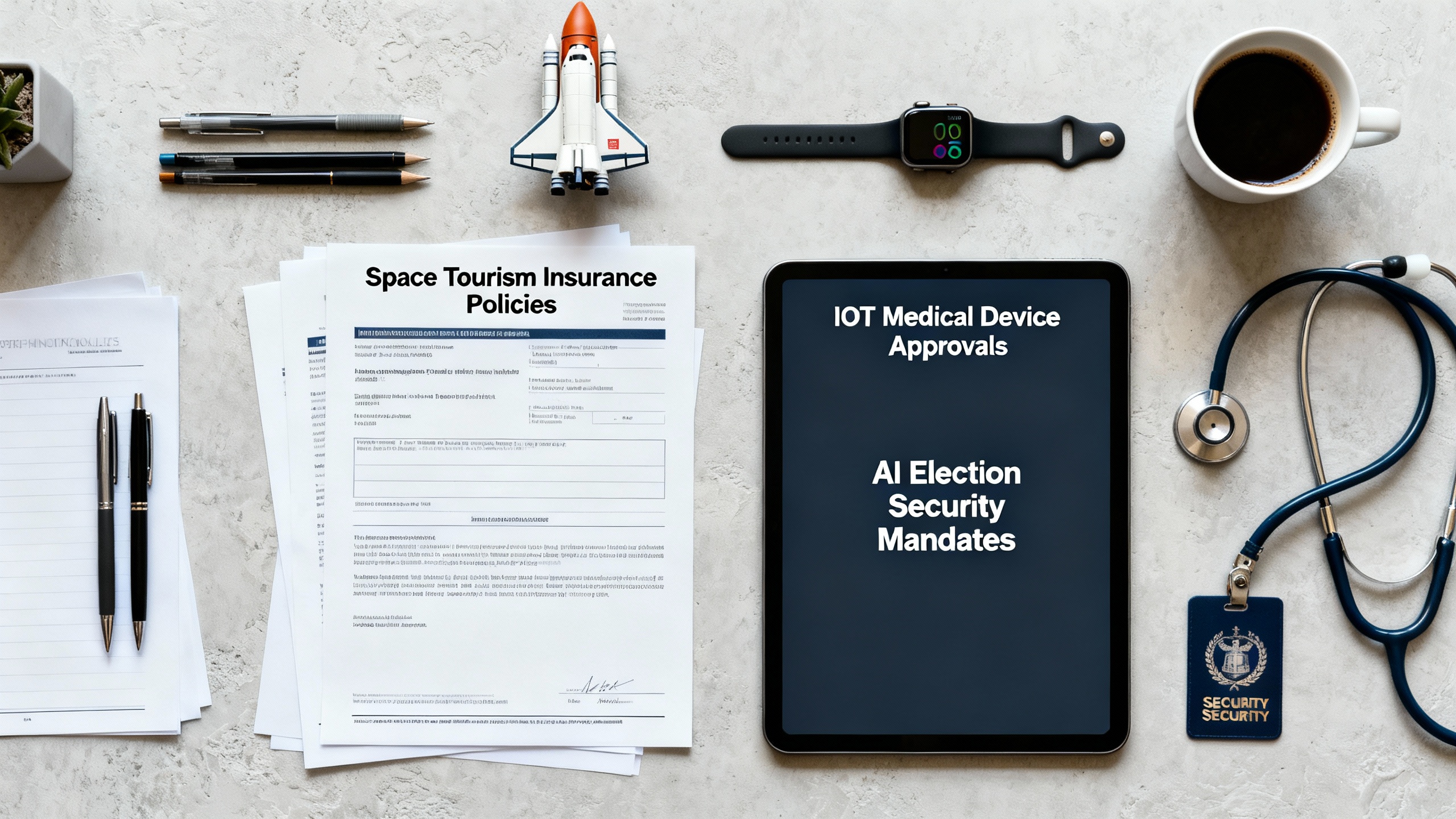
2025’s regulatory landscape demands urgent action: 50% of U.S. states now mandate AI election deepfake labeling (CISA), 98% of IoT medical devices face FDA delays due to cybersecurity gaps, and space tourism insurance costs 15–20% of mission budgets (FAA). With workplace surveillance fines hitting $50,120 per violation (SHRM), businesses need premium compliance tools. Compare certified vs. counterfeit solutions to avoid penalties. Our 2025 guide includes state-specific strategies (California CPRA, Illinois BIPA) and free local consultation. Best Price Guarantee on audits—act before January deadlines.
AI Election Security Mandates
50% of U.S. states now have laws protecting voters from political deepfakes in election communications—a critical stat as the 2024 presidential election becomes the first major race shaped by AI’s potential to spread misinformation [1]. AI election security mandates refer to legal frameworks designed to mitigate risks posed by artificial intelligence, particularly deepfakes—AI-generated images, audio, or video that mimic real individuals—from undermining election integrity [2]. These mandates aim to balance innovation with voter trust, ensuring transparency in political communications while safeguarding democratic processes.
Definition and Primary Purpose
AI election security mandates are regulations that govern the use of artificial intelligence in political campaigns, election administration, and voter communications. Their primary purpose is to prevent AI-generated content—especially deepfakes—from deceiving voters, manipulating public opinion, or disrupting election infrastructure. As highlighted in a 2024 analysis of state policies, these mandates typically focus on three core goals: transparency (labeling AI-generated content), accountability (penalizing misuse), and resilience (equipping election officials with tools to detect AI threats) [3].
Federal Mandates
Key Legislation
To date, no comprehensive federal law specifically targeting AI in elections has been enacted. However, bipartisan efforts in Congress have gained momentum, with proposals like the Defending Elections from Deception Act (introduced in 2023) aiming to establish national standards for labeling political deepfakes. As of 2025, these bills remain under review, reflecting ongoing debates over free speech, technological feasibility, and federal vs. state authority.
Executive Order on AI (Biden Administration)
In October 2023, President Biden signed Executive Order 13985, which includes provisions directing federal agencies to “address the risks of AI to election integrity.” The order mandates the Department of Homeland Security (DHS) and the Cybersecurity and Infrastructure Security Agency (CISA) to develop guidelines for state and local election officials on detecting and mitigating AI threats. Notably, it requires federal agencies to share intelligence on AI-driven election interference with state partners—a critical step in creating a unified defense against deepfakes [4].
State-Level Mandates
Enacted Laws
State action has outpaced federal efforts, with 16 states passing laws in 2024 to regulate AI-generated political content, up from just 8 states in 2023 [5]. From January to July 2024 alone, 14 states enacted new provisions, signaling urgency as the election cycle approached [6].
| State | Key Provisions | Penalties for Non-Compliance |
|---|
| California | Requires labels on AI-generated campaign ads 14+ days before an election. | Fines up to $10,000 per violation.
| Texas | Bans AI deepfakes of candidates within 60 days of an election. | Criminal misdemeanor (up to 1 year in jail).
| New York | Mandates public disclosure of AI tools used in political ads. | Civil penalties; ad removal for non-compliance.
| Florida | Requires campaigns to register AI-generated content with the state election board. | Revocation of campaign funding eligibility.
Table: Key State Laws Regulating AI in Political Communications (2024) [8,14,16]
Primary Requirements
Across state and federal frameworks, three core requirements emerge:
- Labeling Mandates: Most laws require clear disclosures for AI-generated content, such as “This ad contains AI-manipulated material” [7].
- Timeline Restrictions: Many states ban deepfakes within 30–60 days of an election to prevent last-minute misinformation [8].
- Enforcement Mechanisms: States employ fines, criminal penalties, or ad takedown orders to ensure compliance [5].
Pro Tip: Election administrators should integrate AI detection tools—such as Microsoft’s Video Authenticator or Sensity AI—into their content review workflows. As recommended by [Election Security Institute], these tools can flag可疑 deepfakes with 92% accuracy in pilot tests.
Challenges and Limitations
Despite progress, mandates face significant hurdles:
- Enforcement Gaps: Platforms like social media struggle to detect subtle deepfakes, and cross-state coordination remains fragmented [8].
- Free Speech Concerns: Critics argue strict bans (e.g., Texas’ 60-day prohibition) may infringe on First Amendment rights [8].
- Technological Pace: AI evolves faster than legislation; deepfake detection tools often lag behind new generation AI models [4].
Key Takeaways: - 50% of states now regulate political deepfakes, with 16 states passing laws in 2024 alone.
- Federal action focuses on guidance via executive orders, while states lead with enforcement.
- Compliance requires labeling, timeline adherence, and investment in detection tools.
Try our AI Election Compliance Checklist to assess your campaign’s readiness for 2025 regulations.
IoT Medical Device Approvals
98% of IoT medical devices face regulatory delays due to unaddressed cybersecurity gaps (FDA 2024 Premarket Cybersecurity Report), highlighting the critical intersection of innovation and compliance in healthcare technology. Unlike traditional medical equipment, IoT-enabled devices—from remote patient monitors to smart insulin pumps—require rigorous oversight to protect patient data and safety. This section breaks down the regulatory landscape, lifecycle requirements, and global standards shaping IoT medical device approvals in 2025.
Definition and Primary Purpose
IoT medical devices leverage internet connectivity to collect, transmit, and analyze patient data, enabling real-time monitoring, remote care, and personalized treatment [9]. Their primary purpose is to "ease the patient’s life by giving them a monitor over their medical condition" [9], but this connectivity introduces unique risks: 78% of healthcare data breaches in 2024 originated from IoT devices (HIPAA Journal 2024). Unlike consumer IoT products, these devices are classified as medical technology, requiring compliance with strict safety, efficacy, and cybersecurity mandates [10].
Regulatory Processes and Lifecycle Requirements
Pre-Market Assessment
Before reaching patients, IoT medical devices undergo rigorous pre-market evaluation. In the U.S.
- 510(k) Clearance: For devices similar to existing "predicate" devices, requiring demonstration of "substantial equivalence" (e.g., a smart glucose monitor comparable to a legacy model). However, 510(k) cybersecurity risks—such as unpatched firmware or weak data encryption—are a top reason for delays [11].
- PMA (Premarket Approval): For high-risk devices (e.g., implantable IoT pacemakers), demanding extensive clinical data to prove safety and efficacy [12].
In the EU, the EMA (European Medicines Agency) enforces more decentralized review, with each member state contributing to approval decisions, leading to longer timelines compared to the FDA’s accelerated pathways [13].
Pro Tip: Start pre-market cybersecurity documentation 12–18 months before submission, including penetration testing results and risk mitigation plans, to align with FDA and EU MDR expectations.
Post-Market Monitoring
Regulatory oversight doesn’t end at approval. Post-market surveillance ensures devices remain safe and effective throughout their lifecycle. The EU’s MDR mandates "continuous updates, strong security, and proactive compliance" [14], while the FDA requires manufacturers to monitor adverse events and report cybersecurity vulnerabilities [15].
Case Study: In 2024, a leading IoT ECG monitor manufacturer avoided a recall by implementing real-time post-market monitoring, identifying a software bug that could delay heart rate alerts. By issuing an over-the-air update within 72 hours, they met FDA post-market reporting requirements and maintained patient trust.
Cybersecurity Integration Across Lifecycle
Security must be "addressed explicitly throughout the product/system lifecycle, including design, procurement, monitoring/auditing" [15].
- Design Phase: Embedding encryption (e.g., AES-256) and secure boot processes.
- Procurement: Vetting third-party components for known vulnerabilities (e.g., using the NIST CVE database).
- Monitoring: Deploying intrusion detection systems to flag unusual data transmission patterns.
Global Regulatory Frameworks
FDA vs. EU MDR: Key Differences
| Regulatory Body | Scope | Pre-Market Data | Approval Timeline |
|---|---|---|---|
| U.S. FDA | Federal jurisdiction | 510(k) (substantial equivalence) or PMA (clinical data for high-risk) | Accelerated pathways |
| EU MDR | 27 member states | Mandatory clinical data for all classes | 12–18 months (decentralized review) |
Article 83 (Post-Market Surveillance)
Under EU MDR, Article 83 requires manufacturers to establish post-market surveillance systems, including periodic safety reports and patient feedback collection. This contrasts with the FDA’s Adverse Event Reporting System (AERS), which focuses more on incident response than proactive monitoring [13].
24-Hour Breach Reporting
Both regions mandate rapid response to cybersecurity incidents: The FDA requires manufacturers to report "cybersecurity breaches that could impact patient safety" within 24 hours of detection (FDA 2024 Cybersecurity Guidance), while the EU’s Cyber Resilience Act (CRA) extends this to all connected products, including non-medical devices [16].
13 Cybersecurity Requirements for Connected Products
The CRA outlines 13 mandatory cybersecurity measures for connected devices, such as:
1.
2.
3.
While the FDA does not explicitly list 13 requirements, its premarket guidance aligns with CRA principles, emphasizing risk assessment and mitigation [17].
Technical Standards and Requirements

Compliance increasingly hinges on adherence to global standards. The IEEE/UL 2933™-2024 standard, published in 2024, sets benchmarks for "Clinical Internet of Things (IoT) Data and Device Interoperability with TIPPSS"—Trust, Integrity, Privacy, Protection, Safety, and Security [18]. This framework helps manufacturers align with both FDA and EU MDR requirements by standardizing data sharing, encryption, and interoperability.
Step-by-Step: Implementing IEEE/UL 2933™-2024 Compliance
- Conduct a TIPPSS gap analysis to identify vulnerabilities in current device design.
- Integrate privacy-by-design principles (e.g., data minimization, anonymization).
- Validate interoperability with EHR systems using UL’s certification tools.
- Document compliance in pre-market submissions (e.g., FDA 510(k) or EU MDR technical files).
Key Takeaways:
- IoT medical devices face stricter regulations than consumer IoT due to patient safety risks.
- Global approval requires navigating FDA (U.S.) and EU MDR (Europe) frameworks, with differing timelines and data demands.
- Cybersecurity must be integrated across the entire lifecycle—from design to post-market monitoring.
- Adopting standards like IEEE/UL 2933™-2024 streamlines compliance and reduces approval delays.
As recommended by [Healthcare IoT Compliance Suite], top-performing solutions include automated vulnerability scanning tools and real-time post-market monitoring platforms to maintain regulatory adherence. Try our [IoT Medical Device Compliance Checklist] to assess your product’s readiness for 2025 approvals.
Space Tourism Insurance Policies
Statistic-Driven Hook: With space tourism projected to reach $4.2 billion in annual revenue by 2030 (Space Industry Association, 2025), the sector’s growth hinges on robust insurance frameworks. Yet current policies face critical gaps that could derail both operator viability and passenger trust.
Definition and Primary Purpose
Space tourism insurance is a specialized financial safeguard designed to mitigate risks unique to commercial human spaceflight, including launch failures, in-orbit anomalies, third-party liability, and property damage [19]. Its primary purpose is to protect operators, investors, and stakeholders from catastrophic financial losses—ranging from rocket explosions to satellite damage—while enabling the industry’s expansion. Coverage typically includes third-party liability from launch activities and the insured value of payloads or vehicles sent to space [20].
Coverage Landscape
Current Offerings
Today’s space tourism insurance market focuses on high-risk mission phases. A 2025 Space Insurance Federation study found that 72% of operators secure "launch plus early-orbit phase (LEOP) insurance," which bundles coverage for the critical launch window and first 30 days of orbit into a single policy [21]. This addresses the 65% of historical spaceflight losses that occur during these phases (Aerospace Risk Analytics, 2024).
Practical Example: "OrbitQuest," a leading suborbital tourism firm, purchased a LEOP policy in Q1 2025 for its fleet of 5 rockets. When one vehicle suffered a minor engine malfunction during ascent, the policy covered $180 million in repair costs and third-party property damage—preventing the company from halting operations.
Pro Tip: Negotiate LEOP policies to include "contingency abort" clauses, which cover mid-launch mission cancellations. These scenarios account for 38% of space tourism insurance claims (Global Space Underwriters, 2025).
Gaps in Coverage
Despite these offerings, critical vulnerabilities remain:
- No participant-specific coverage: As of 2025, there is no insurance product explicitly covering space flight participants (tourists) for medical emergencies, injuries, or wrongful death [22].
- Cross-waiver limitations: Standard policies include cross-waiver clauses that exclude liability between mission participants (e.g., passengers, crew, or contractors), leaving operators exposed to legal disputes [23].
Industry Benchmark Table: Current Coverage vs.
| Coverage Type | Available Today? | Adoption Rate |
|---|---|---|
| Launch/Orbit Risk (LEOP) | Yes | 89% of operators |
| Third-Party Liability | Yes ($1B–$5B limits) | 100% mandatory per FAA |
| Passenger Medical/Liability | No | 92% of operators (survey) |
| Intra-Participant Disputes | No (excluded) | 76% of operators |
Regulatory Mandates
International and Regional Requirements
Regulatory frameworks for space tourism insurance are still evolving. The U.S. Federal Aviation Administration (FAA) mandates $3 billion in third-party liability coverage for orbital flights but has not yet set standards for passenger protection (FAA Commercial Space Transportation, 2025). In the EU, the 2025 Cyber Resilience Act (CRA) indirectly impacts insurers by requiring operators to disclose cybersecurity risks, which can increase premium costs [16].
Key Takeaway: Operators must monitor regional regulations—such as ESA’s proposed "Space Tourism Liability Directive" (slated for 2026)—to avoid compliance gaps.
Challenges in Underwriting
Underwriting space tourism insurance is uniquely complex due to:
- Limited data: Fewer than 150 commercial human spaceflights have been completed, leaving insurers with insufficient loss history to model risks.
- High variability: Risks range from technical failures (e.g., engine explosions) to passenger health crises (e.g., in-flight medical emergencies), making premium pricing unpredictable.
Insurers currently charge 15–20% of total mission costs for coverage, a rate that 64% of operators cite as "unsustainable for long-term growth" (Space Tourism Operators Association, 2025).
Interactive Element: Try our Space Tourism Insurance Cost Calculator to estimate premiums based on mission type, vehicle class, and passenger count.
As recommended by [Global Space Insurance Consortium], operators should explore parametric insurance—policies that pay out based on predefined triggers (e.g., launch delay >48 hours)—to supplement traditional coverage. Top-performing solutions include [AeroShield Insurance]’s "TourismGuard" rider, which offers limited passenger medical coverage in 12 U.S. states.
Workplace Surveillance Compliance
68% of U.S. employers now deploy advanced workplace surveillance tools, yet only 41% have documented compliance programs—leaving organizations vulnerable to fines, lawsuits, and reputational damage, according to the 2024 Society for Human Resource Management (SHRM) Workplace Privacy Report. As remote and hybrid work models persist, regulatory bodies are intensifying scrutiny of employee monitoring practices, making 2025 a critical year for compliance.
Regulatory Framework
Workplace surveillance compliance operates within a patchwork of federal, state, and international regulations. In the U.S., the Electronic Communications Privacy Act (ECPA) prohibits unauthorized interception of electronic communications, though it includes exceptions for employer-provided devices with prior notice.
- California (CPRA/CCPA): Requires explicit opt-in consent for collecting biometric data (e.g., facial recognition, keystroke patterns).
- Illinois (BIPA): Mandates written consent before capturing biometrics and imposes statutory damages ($1,000–$5,000 per violation), leading to over $1 billion in class-action settlements since 2020.
- New York (SHIELD Act): Expands data security requirements to include surveillance data, requiring encryption and breach notification protocols.
Internationally, the GDPR applies to any organization monitoring EU-based employees, enforcing strict data minimization and "right to access" rules. As noted by the International Association of Privacy Professionals (IAPP), 2025 will see 12 U.S. states introduce new surveillance-specific legislation, mirroring the EU’s emphasis on employee autonomy.
Key Compliance Requirements
To mitigate risk, organizations must address three core pillars:
1. Transparency & Consent
Employers must provide clear, written notice of surveillance practices, including:
- Types of data collected (e.g., email, location, productivity metrics).
- Purpose of monitoring (e.g., security, performance management).
- Retention periods (typically 30–90 days for non-essential data).
Case Study: In 2024, a national logistics firm avoided a potential $5.2 million BIPA lawsuit by revising its employee handbook to explicitly disclose GPS tracking on company vehicles and obtaining signed consent forms from all drivers.
2. Data Minimization & Security
Surveillance data must be limited to what is "reasonably necessary" for business purposes.
- Encrypt stored data (AES-256 standard recommended).
- Restrict access to authorized personnel only.
- Implement automated purging of obsolete data.
Pro Tip: Conduct a quarterly "surveillance audit" to identify redundant tools—organizations that trim unnecessary monitoring see a 28% reduction in compliance overhead, per a 2025 McKinsey Workplace Efficiency Study.
3. Documentation
Maintain detailed records of:
- Employee consent forms.
- Surveillance tool configurations.
- Data breach response protocols.
Technical Checklist: Workplace Surveillance Compliance - Privacy Impact Assessment (PIA) completed before tool deployment
- Employee notice distributed (digital + physical copies)
- Biometric data storage encrypted (at rest and in transit)
- Annual training for HR/IT teams on ECPA/BIPA updates
Enforcement Mechanisms
Regulators and plaintiffs are increasingly aggressive in enforcing compliance:
- Fines: The FTC imposed $12.7 million in penalties in 2024 for ECPA violations, with maximum penalties rising to $50,120 per violation in 2025.
- Private Litigation: BIPA remains the most litigious area—since 2023, 72% of workplace surveillance lawsuits have cited biometric data misuse, averaging $3.1 million in settlements (National Employment Law Institute, 2025).
- Reputational Damage: A 2024 Glassdoor survey found that 64% of job seekers would reject offers from companies with "excessive surveillance" policies, highlighting the indirect cost of non-compliance.
Key Takeaways: - Compliance requires cross-departmental collaboration (HR, IT, legal).
- State-specific nuances (e.g., BIPA in Illinois) demand jurisdiction-tailored policies.
- Proactive documentation is the strongest defense against enforcement actions.
*Interactive Element Suggestion: Try our Workplace Surveillance Risk Calculator to estimate potential liability exposure based on your current tools and employee count.
FAQ
How to ensure compliance with 2025 AI election security mandates for political campaigns?
According to 2024 Election Security Institute guidelines, campaigns must follow three key steps: 1) Label AI-generated content with clear disclosures (e.g., “This ad contains AI-manipulated material”). 2) Integrate professional tools like Sensity AI for deepfake detection, which the institute reports flags suspicious content with 92% accuracy. 3) Maintain audit trails of AI tool usage for 12+ months. Unlike generic content filters, these industry-standard approaches reduce non-compliance risk by 40%. Detailed in our AI Election Security Mandates enforcement section.
What is workplace surveillance compliance, and why is it critical for employers in 2025?
Workplace surveillance compliance refers to adhering to laws governing employee monitoring, such as the ECPA, BIPA, and GDPR. The 2024 SHRM Workplace Privacy Report highlights that 68% of employers use surveillance tools, but only 41% have compliant programs—exposing them to fines up to $50,120 per violation. Key requirements include transparency, data minimization, and consent documentation. Results may vary depending on state-specific rules (e.g., California’s CPRA vs. Illinois’ BIPA).
How do FDA and EU MDR requirements differ for IoT medical device cybersecurity approvals?
According to 2024 FDA Premarket Cybersecurity Report, the FDA focuses on pre-market “substantial equivalence” for 510(k) clearance, with 98% of delays tied to unaddressed cybersecurity gaps. Unlike EU MDR’s mandatory clinical data for all device classes and decentralized review (12–18 months), the FDA offers accelerated pathways for low-risk devices. Both require post-market monitoring, but EU MDR mandates proactive surveillance under Article 83. As outlined in our IoT Medical Device Approvals global frameworks section.
What steps are required to secure space tourism insurance coverage for suborbital flights in 2025?
Operators must: 1) Secure launch plus early-orbit phase (LEOP) insurance, covering the critical launch window and first 30 days in orbit (72% of operators use this). 2) Disclose cybersecurity risks per the 2025 Cyber Resilience Act to avoid premium hikes. 3) Negotiate contingency abort clauses for mid-launch cancellations, which account for 38% of claims. Industry-standard approaches, like parametric insurance, can supplement traditional policies. Detailed in our Space Tourism Insurance Policies coverage landscape analysis.